
17 December, 2025
Last conference of 2025: Svemin’s Exploration Day
Founder and President of GeoPool, Mathias Forss, shares his strategic highlights from Svemin’s Exploration Day held in Stockholm on the 9th of December.
Are We Gaining Speed, or Losing Ground?
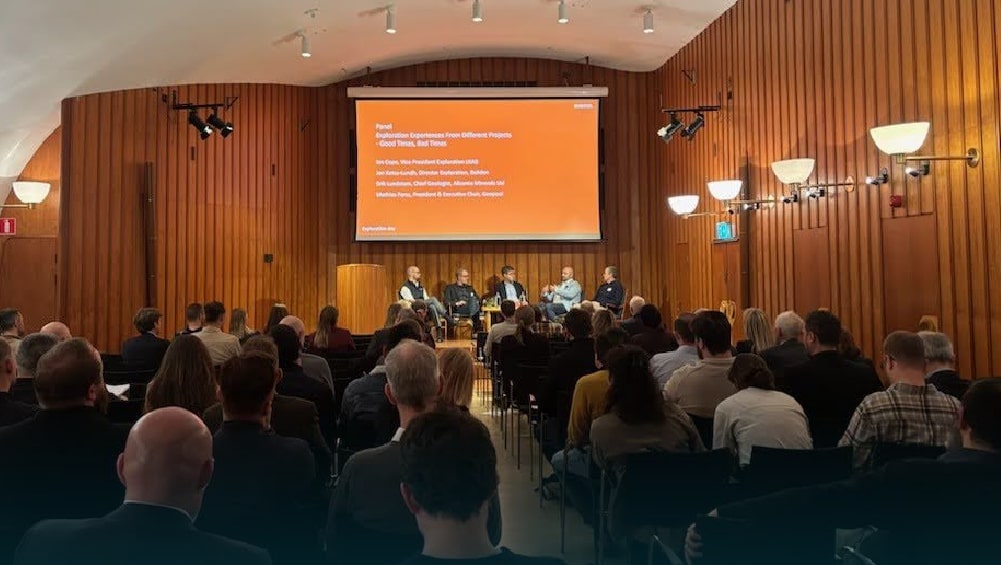
At the Exploration Day event, industry professionals in mineral exploration, research, and decision-making presented their insights. I gave a presentation comparing Sweden to Finland and Norway, with a particular focus on mineral exploration processes in Sweden. I also took part in a panel talk about exploration in Sweden.
The EU and Sweden, at the national level, are gaining momentum, which is very positive. Looking at the whole of Sweden and Finland and comparing to regional and local levels, this isn’t always the case. I find that interesting, since the whole country has the same Mining/Mineral Act and other related regulations. One important aspect lies in the processes, both in permitting, where we try to contribute as effectively as possible, and in the part where the exploration companies and we can make a direct impact, which is within communication.
Market Signals and Operational Reality
In June 2025, I wrote about the permitting changes in Sweden and Finland, and about changes in the Mining/Mineral Act that were affected. Since then, the gold price has increased, and both copper and silver seem to be picking up. In Sweden, there has been a lot of discussion about the uranium ban, whereas in Finland, there has been much discussion about the mining tax. In practice, given the number of new applications, the recent increase in metal prices has not yet led to a noticeable increase in applications submitted to the authorities in Sweden. The total area covered by valid exploration permits remains roughly the same as a year ago, at approximately 12 300 km². I believe this is because exploration companies receiving funding now conduct their work under existing permits, rather than applying for new ones. The number of new companies entering is roughly equal to the number of companies that have been unable to raise funding and have either not extended their permits or left the Nordics.
The Communication Challenge in Mineral Exploration
When it comes to communication, I’ve found that the distinction between exploration and mining is often very confusing to those outside the industry. But when we focus specifically on mineral exploration, we also face communication challenges. At the early stage, exploration companies do not yet know whether there is any mineralisation underground, as this can only be determined through field studies. And if there is a hint of mineralisation, raising further interest in exploration work, the area of investigation decreases, and the exploration method changes. This phase may last anywhere from 1 to 10 years, and communicating along these two dimensions – methods and timeline – can be challenging, as most people haven’t learned about mineral exploration in schools and are unfamiliar with the industry’s role in society.
Both the short-term and long-term aspects change – for the exploration company, the landowners and stakeholders, as well as in mining laws, regulations, procedures, and the development of exploration methods and the industry as a whole. Looking at the history, it is also clear that there are significant differences between counties and municipalities, as well as in their understanding of the distinction between mining and exploration.
Permitting Costs in the Nordics
I compiled permitting costs in Sweden, Norway, and Finland to show the cost of securing the ground. It is very difficult to compare countries, as many factors depend on area and different regulations. However, if we take a theoretical 5 km² area (500 ha) and a company looking to explore the area for 5 years (without restrictions), the authority fees regulated in the Mining/Mineral Acts for each country for just having the permit are close to the following.
In Norway and Sweden, permit costs are about 4–5K CAD, and under the respective Mining Acts, the permit doesn’t grant the company any exploration rights. Additional permits are required to carry out exploration work, and these costs are not included. In Finland, there are two types of permits: a reservation typically valid for 12 months, which operates at the same legal level as in Sweden and Norway – meaning no other company can apply for permits in that area, and the reserving company has first rights (Norway has a queue system, but let’s ignore that for now).
In Finland, the reservation fee is about 5K CAD, and if the area is later converted to an exploration permit, the subsequent four years typically cost around 71K CAD. A major difference compared with Norway and Sweden is that roughly 90% of this amount (depending on the area) is compensated to the landowner. Another difference is that in Finland, the exploration methods defined in the application are then approved, without requiring separate consent from other authorities. The company has the needed permits from the moment the mining authority’s decision gains legal validity. Before starting exploration work, it is required to inform landowners and stakeholders well in advance about the planned activities. This promotes transparency and effective communication.